
 By Recharge Info hub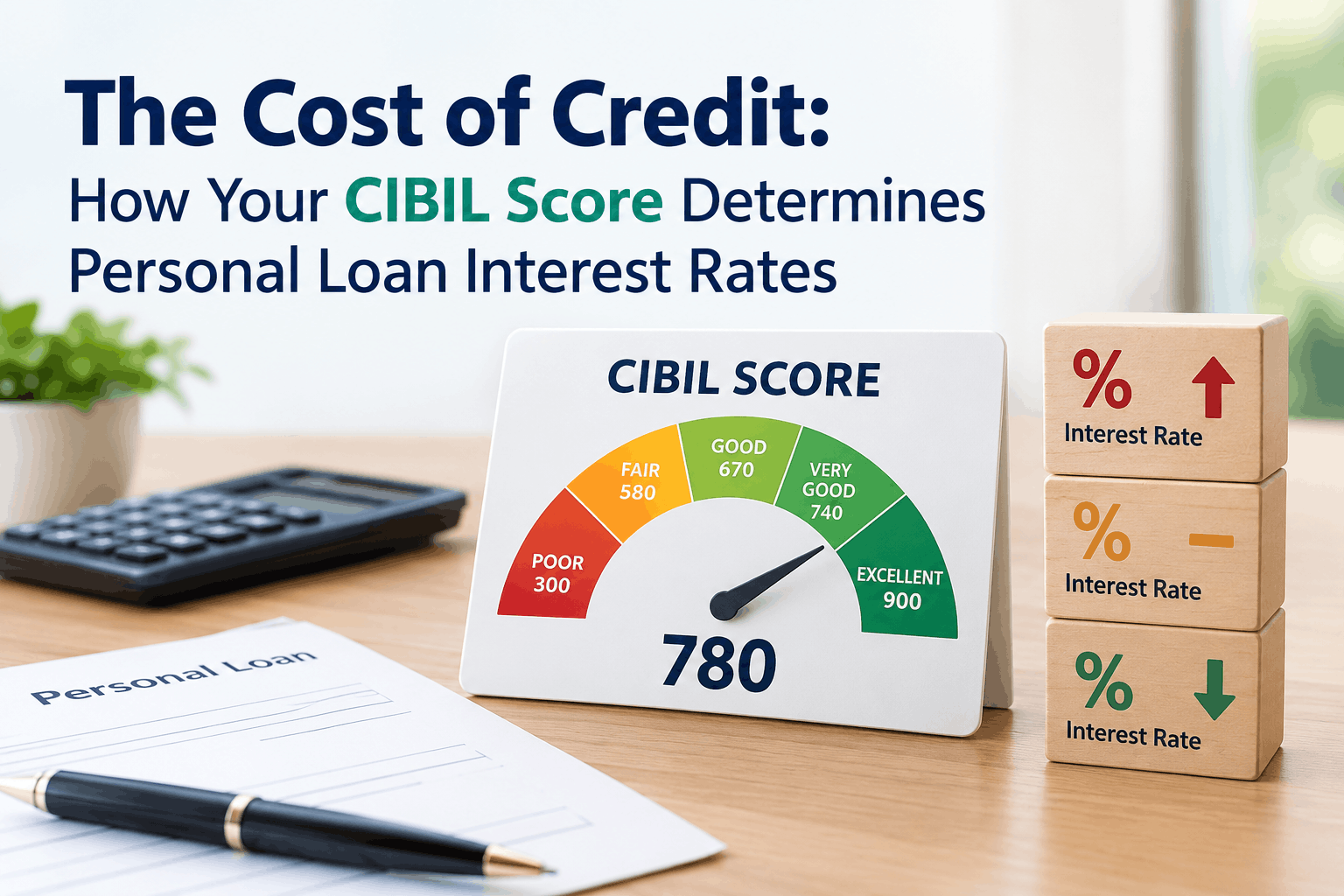
When you apply for a personal loan, financial institutions are essentially gauging one critical factor: risk. Because personal loans are unsecured—meaning they require no collateral like a house or car—lenders have no physical asset to seize if you default. To offset this risk, banks and Non-Banking Financial Companies (NBFCs) rely heavily on your credit history. In India, the primary metric used for this evaluation is your CIBIL score, managed by TransUnion CIBIL.
Your CIBIL score acts as a financial passport. A high score signals disciplined financial behavior, while a low score suggests potential risk. This article provides an in-depth analysis of how your CIBIL score directly influences the interest rates offered on personal loans, how lenders price their credit products, and what concrete steps you can take to secure the most favorable borrowing terms.
Understanding the CIBIL Score Spectrum for Personal Loans
The CIBIL score is a three-digit numerical summary of your credit history, ranging from 300 to 900. Lenders typically categorize these scores into distinct brackets to quickly assess your creditworthiness. Understanding where you fall on this spectrum is the first step in predicting your borrowing costs.
The Elite Tier: 750 to 900
An individual with a score in this range is viewed as highly reliable. Borrowers in this bracket have a pristine track record of timely repayments, low credit utilization, and a balanced mix of credit. For this tier, lenders offer their lowest interest rates, fastest processing times, and often waive processing fees or offer pre-approved personal loan deals.
The Good Tier: 700 to 749
This is a solid, respectable bracket. Lenders view these applicants as low-to-moderate risk. While you may not qualify for the absolute lowest promotional rates, you will still secure highly competitive personal loan terms with a wide choice of lenders. Minor credit blemishes might exist, but they are not severe enough to deter institutional trust.
The Average Tier: 650 to 699
Borrowers in this range are considered moderate risk. You may have experienced occasional late payments, high credit card utilization, or a high volume of unsecured loan inquiries. While you can still obtain a personal loan, your interest rates will be notably higher, and the lender may impose stricter documentation requirements or lower your requested loan amount.
The Subprime Tier: Below 650
Scores below 650 indicate significant credit distress, such as defaults, written-off accounts, or severe payment delays. Standard public and private sector banks are highly likely to reject applications in this bracket. Specialized NBFCs or peer-to-peer lending platforms may consider these applications, but they will charge premium interest rates to compensate for the elevated risk of default.
The Mechanics of Risk-Based Pricing
To understand why your CIBIL score has such a profound impact on your pocketbook, it is necessary to understand “risk-based pricing.” This is a methodology used by financial institutions where the interest rate of a loan is customized to the individual borrower’s credit profile.
Lenders calculate their cost of funds, operational expenses, and a target profit margin. To this baseline, they add a “risk premium.” The higher your credit risk (implied by a lower CIBIL score), the higher the risk premium added to your interest rate. Conversely, an applicant with a stellar credit score requires almost no risk premium, allowing the lender to offer rates closer to their base lending rate.
For instance, a borrower with a CIBIL score of 800 might be offered a personal loan at a competitive rate of 10.50% per annum. Meanwhile, a borrower with a score of 670 applying to the same lender for the exact same loan amount and tenure might be quoted an interest rate of 15.50% or higher. Over a multi-year tenure, this five-percent variance translates to thousands of rupees in extra interest outlays.
Beyond the Number: Crucial Details in Your CIBIL Report
While the three-digit score is the headline figure, lenders dive deeper into your full CIBIL report during the underwriting process. Several specific factors within the report can sway the final interest rate offer:
- Payment History (DPD): The “Days Past Due” (DPD) section shows how many days past the due date you paid your bills. Any entry other than “000” (which indicates on-time payment) can raise flags, even if your overall score seems acceptable.
- Credit Utilization Ratio (CUR): This is the percentage of your total available credit limit that you actively use. Maintaining a CUR above 30% suggests high dependency on credit and can negatively influence the interest rates offered.
- Credit Mix: Lenders prefer to see a healthy balance of secured credit (like home or car loans) and unsecured credit (like credit cards and personal loans). An over-reliance on unsecured credit can signal higher risk.
- Hard Inquiries: Every time you formally apply for a personal loan or credit card, the lender initiates a “hard inquiry” on your CIBIL report. Multiple hard inquiries within a short period indicate credit hunger, lowering your credit score and driving up offered interest rates.
The Financial Impact: A Real-World Cost Analysis
To illustrate the tangible financial consequences of your CIBIL score on a personal loan, let us look at a hypothetical scenario. Consider three different borrowers applying for a personal loan of INR 5,00,000 with a repayment tenure of 5 years (60 months).
| Borrower Profile | CIBIL Score Range | Assumed Interest Rate (p.a.) | Monthly EMI (INR) | Total Interest Payable (INR) | Total Outflow (INR) |
|---|---|---|---|---|---|
| Borrower A (Excellent) | 750 – 900 | 10.50% | 10,747 | 1,44,817 | 6,44,817 |
| Borrower B (Good/Average) | 700 – 749 | 13.50% | 11,504 | 1,90,230 | 6,90,230 |
| Borrower C (Fair/Poor) | 650 – 699 | 18.00% | 12,697 | 2,61,803 | 7,61,803 |
As demonstrated above, Borrower C, with a lower CIBIL score, pays INR 1,16,986 more in interest than Borrower A for the exact same principal loan amount. This stark difference highlights that maintaining a strong credit profile is not just a matter of pride, but a significant financial strategy that directly preserves your disposable income.
Actionable Steps to Optimize Your CIBIL Score Before Applying
If you plan to apply for a personal loan in the near future, it is highly beneficial to review and improve your credit profile beforehand. Taking proactive steps can shift your application into a higher score bracket, saving you substantial money over the life of the loan.
1. Check Your Credit Report for Errors
Obtain a free copy of your CIBIL report. Carefully verify that all listed accounts, loan balances, and personal details are accurate. It is not uncommon to find erroneous defaults or open accounts that you have already closed. If you find inaccuracies, raise a dispute immediately through the official CIBIL online dispute resolution portal.
2. Bring Your Credit Utilization Below 30%
If you consistently max out your credit cards, pay down the outstanding balances before the next reporting cycle. Reducing your credit utilization ratio is one of the fastest ways to give your CIBIL score a positive boost.
3. Pay Off Minor Outstanding Debts
If you have small, lingering debts or overdue credit card bills, clear them entirely. Even a single unpaid bill of a nominal amount can drag down your score and paint an unfavorable picture of your financial discipline to potential lenders.
4. Avoid Making Multiple Hard Inquiries
Do not apply to multiple lenders simultaneously to “shop around” for rates. Each application triggers a hard inquiry, which damages your score. Instead, use online eligibility calculators or seek soft-pull quotes (which do not affect your credit score) to compare indicative terms before submitting a formal application.
Applicant Checklist and Frequently Asked Questions
Pre-Application Decision Checklist
- Have you retrieved and thoroughly checked your CIBIL report in the last 30 days?
- Is your current CIBIL score above 750? (If not, can you delay the loan to improve it?)
- Is your overall Credit Utilization Ratio below 30%?
- Have you ensured there are no “Days Past Due” (DPD) entries other than “000” on your recent history?
- Have you calculated your Debt-to-Income ratio to ensure your total monthly EMI obligations (including the prospective loan) do not exceed 45% of your net monthly income?
Frequently Asked Questions
Can I get a personal loan with a CIBIL score below 600?
Yes, but it is challenging. Traditional banks will likely reject the application. You will have to approach digital lending platforms, peer-to-peer networks, or specialized NBFCs. These institutions will charge significantly higher interest rates, require a co-signer, or ask for proof of stable, high monthly income to mitigate their risk.
How long does it take for credit score improvements to reflect?
Credit bureaus typically update their databases every 30 to 45 days. If you settle an outstanding balance or correct an error, expect to see the positive impact on your CIBIL score reflected within one to two reporting cycles.
Does checking my own CIBIL score reduce it?
No. When you check your own credit score, it is classified as a “soft inquiry” and has absolutely no impact on your credit rating. Only “hard inquiries” initiated by lenders when you apply for credit affect your score.
Do all lenders offer the same interest rates for a specific CIBIL score?
No. Every bank and NBFC has its own internal risk assessment framework, target demographics, and cost of funds. While your CIBIL score is a universal benchmark, the exact interest rate mapped to that score will vary from lender to lender. Always compare options before making a final commitment.
Conclusion
Your CIBIL score is the single most powerful tool you possess when navigating the personal loan market. It dictates not only whether you will be approved, but also the overall cost of your debt. By understanding the mechanics of risk-based pricing, monitoring your credit report for inaccuracies, and practicing disciplined repayment habits, you can command the lowest interest rates, minimize your borrowing costs, and make personal loans a highly effective tool for your financial growth.
Featured image via Paramount – Artcraft Pictures — Wikimedia Commons (Public domain).