
 By Recharge Info hub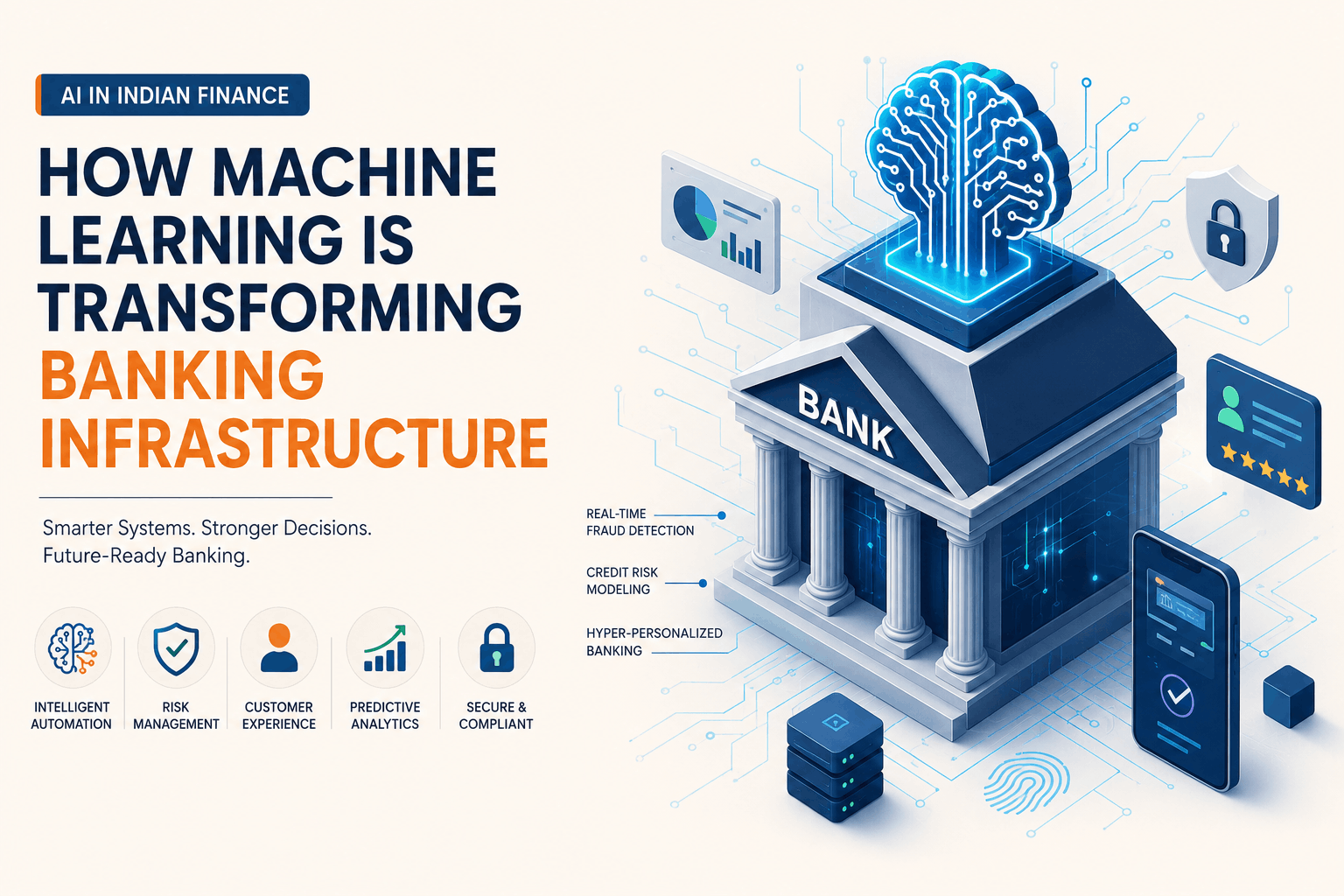
The global financial landscape is undergoing a massive paradigm shift, driven by rapid advancements in artificial intelligence (AI) and machine learning (ML). Among the world’s major economies, India has emerged as a key hub for these digital transformations. Driven by a robust digital public infrastructure (DPI)—popularly known as the “India Stack”—and widespread mobile connectivity, Indian financial institutions are rapidly transitioning from legacy systems to AI-first architectures.
This comprehensive analysis explores how Indian banks, fintech enterprises, and regulatory bodies are deploying machine learning to enhance operational efficiency, manage risk, and foster financial inclusion across a highly diverse population.
The Shift to AI-First Banking in India
For decades, Indian banking relied heavily on physical branches and manual verification processes. The introduction of the Unified Payments Interface (UPI) and digital identity verification (Aadhaar) dramatically lowered the barrier to entry for millions of unbanked citizens. Today, the challenge has shifted from basic digital access to intelligent processing.
Indian financial institutions are no longer viewing AI as an experimental tool for niche applications. Instead, machine learning algorithms are being integrated into core banking systems to automate decision-making processes, analyze vast datasets in real time, and deliver personalized services. This transition is motivated by the need to scale operations efficiently in a market characterized by high-volume, low-ticket transactions.
Core Use Cases of Machine Learning in Indian Financial Institutions
To understand the depth of this technological shift, it is essential to examine the specific domains where machine learning is actively deployed.
1. Credit Scoring and Alternative Data for Underserved Markets
Historically, a significant portion of the Indian population lacked a formal credit history, making it difficult for traditional banks to assess creditworthiness. Under legacy systems, these individuals were often excluded from formal credit markets or forced to rely on informal, high-interest lenders.
Machine learning models have revolutionized credit underwriting by analyzing alternative data streams. These include:
- Utility and Mobile Bill Payments: Consistency in paying recurring bills as an indicator of financial discipline.
- Transaction Patterns: Analyzing digital transaction velocity and volume via UPI and digital wallets.
- Socio-Demographic and Behavioral Data: Digital footprints and mobile usage patterns processed through privacy-compliant ML algorithms.
By leveraging these non-traditional data points, ML models can generate highly accurate risk profiles for first-time borrowers, enabling banks to extend micro-loans and working capital to small and medium enterprises (SMEs) with minimal default rates.
2. Vernacular Conversational AI for Financial Inclusion
India is a multilingual nation with dozens of officially recognized languages and hundreds of dialects. Delivering banking services in English or Hindi alone excludes a vast segment of the population. To address this, banks are deploying advanced conversational AI and Natural Language Processing (NLP) engines.
These voice-activated and text-based virtual assistants can understand regional dialects, code-switching (mixing English with local languages, such as “Hinglish”), and colloquial phrasing. Customers can check balances, transfer funds, and apply for services simply by speaking to their mobile devices, significantly reducing the digital literacy barrier.
3. Real-Time Fraud Detection and Cybersecurity
As digital transactions surge, so does the sophistication of cyber threats and financial fraud. Traditional rule-based security systems, which rely on static parameters, are often insufficient to counter dynamic fraud tactics. Indian financial institutions are deploying ML-based anomaly detection engines to monitor transactions in real time.
These algorithms analyze historical transaction profiles, geolocation data, device signatures, and behavioral biometrics to flag suspicious activity instantly. If a transaction deviates significantly from an established pattern, the system can automatically freeze the transaction or request multi-factor authentication, protecting both the consumer and the institution.
How Major Indian Banks Are Implementing AI
Both public and private sector banks in India are executing distinct strategies to integrate artificial intelligence into their operations. While private banks often lead in customer-facing innovations, public sector undertakings (PSUs) are leveraging AI to optimize large-scale public distribution and agricultural credit systems.
Private lenders have focused heavily on hyper-personalization. By deploying predictive analytics, these institutions analyze customer spending habits to offer tailored investment advice, insurance products, and pre-approved loans at the precise moment of customer need. Additionally, robotic process automation (RPA) combined with cognitive document processing has reduced loan approval times from days to minutes.
On the other hand, major public sector institutions are utilizing AI to manage risk across vast, nationwide networks. Machine learning algorithms are deployed to monitor early warning signals (EWS) of non-performing assets (NPAs), helping banks identify stressed accounts before they default. This proactive risk management is crucial for maintaining systemic stability in a developing economy.
Regulatory Frameworks and Ethical AI in Indian Finance
The integration of AI in banking brings significant regulatory responsibilities. The Reserve Bank of India (RBI) maintains a watchful eye on how technology impacts financial stability, data privacy, and consumer protection. Financial regulations and compliance mandates vary significantly by region and institution, making continuous alignment with regulatory authorities essential.
Key regulatory priorities in the Indian context include:
- Data Localization and Privacy: Ensuring that customer financial data is stored and processed securely within national borders, complying with the Digital Personal Data Protection (DPDP) Act.
- Explainable AI (XAI): Regulators emphasize that credit decisions or loan denials made by algorithms must be explainable. Black-box models that cannot justify their outputs face strict scrutiny.
- Algorithmic Bias: Financial institutions are required to regularly audit their ML models to ensure they do not perpetuate biases against specific demographics, regions, or socio-economic classes.
Challenges in Scaling AI Across Indian Banking
While the potential of AI is immense, several hurdles remain to be solved before widespread, seamless adoption can be achieved.
Legacy Infrastructure: Many older institutions operate on highly fragmented, legacy core-banking systems. Integrating advanced machine learning models with these outdated platforms requires significant capital and time.
Data Quality and Silos: AI models are only as good as the data they are trained on. In many banks, valuable customer data remains locked in departmental silos (e.g., credit cards, mortgages, and wealth management operating independently), preventing a unified customer view.
Talent Shortage: There is intense global competition for high-tier AI and data science talent. Indian banks must compete not only with local fintech startups but also with multinational technology giants to attract and retain specialized professionals.
The Future of AI-Driven Banking: What Lies Ahead
Looking forward, the integration of generative AI (GenAI) is poised to be the next frontier in banking technology. Beyond standard customer support, GenAI is being explored for automated financial planning, complex code generation for internal software development, and highly customized risk-scenario modeling.
Furthermore, as the Open Credit Network and Account Aggregator frameworks continue to mature in India, the volume of consensual, structured financial data available will grow exponentially. This will provide machine learning models with the high-quality training sets required to build even more precise predictive tools, further lowering transaction costs and expanding credit access.
Checklist: Evaluating AI Readiness in Financial Operations
For financial enterprises looking to deploy or upgrade their machine learning infrastructure, this strategic checklist serves as an operational roadmap:
- Data Governance: Are your data storage, cleaning, and labeling processes compliant with local data protection laws (e.g., DPDP Act)?
- Model Explainability: Can your data scientists explain how your credit risk or fraud detection models arrive at specific conclusions?
- Integration Capabilities: Do your legacy core banking systems support secure API integrations with modern ML middleware?
- Scalability and Latency: Can your fraud detection models process high-volume transactions with sub-second latency?
- Bias Auditing: Is there an established, ongoing protocol to test algorithms for demographic or socio-economic bias?
Frequently Asked Questions (FAQ)
How does machine learning differ from traditional banking software?
Traditional banking software relies on fixed, hard-coded rules (e.g., “if account balance is below X, apply fee Y”). Machine learning, however, analyzes historical data patterns to make predictions, learn from new information, and adapt to evolving customer behaviors or fraud tactics without explicit reprogramming.
Are AI-driven credit decisions legally binding in India?
While AI can automate the risk-assessment process, the ultimate legal responsibility for credit approval and compliance rests with the regulated financial entity. Banks must ensure human-in-the-loop oversight and verify that all algorithmic decisions adhere to Reserve Bank of India (RBI) guidelines.
How does AI help in reducing banking operational costs?
AI reduces costs by automating high-volume, repetitive tasks such as document verification (e-KYC), basic customer queries via chatbots, and manual data entry. This allows human personnel to focus on complex advisory roles, high-value risk assessments, and customer relationship management.
Can machine learning completely eliminate financial fraud?
No system can guarantee 100% protection against fraud, as bad actors continuously adapt their strategies. However, machine learning significantly reduces risk by identifying complex fraud patterns and anomalies in real time that human analysts or static rule-based systems would likely miss.
Featured image via Sinar Mas Multiartha — Wikimedia Commons (Public domain).